Why you need a route here
The Palatine Gallery is not a modern museum. It is a quadreria — a princely picture hall where paintings hang three and four high on crimson walls, arranged for decorative symmetry, not chronology. A Raphael can sit above a doorway; a Titian shares a wall with a dozen lesser names. Without a plan, visitors drift past masterpieces they crossed the world to see.
The fix is simple: know which hall each work is in and what to look for. The ten stops below follow the gallery's one-way circuit through the planetary halls. Halls occasionally close or works travel to exhibitions — the room names let you re-order on the spot. Covered by every palace ticket.
The 10-stop route through the Palatine Gallery
1. Raphael, Madonna della Seggiola — Saturn Hall
The gallery's signature image: Mary hugging the Christ Child in a perfect circle, painted around 1513–14. The tondo format is the point — Raphael bends mother, child and the young St John into the curve so naturally that you stop noticing the frame is round. Look for: how the Virgin's knee and elbow press against the circle's edge, locking the composition like a coiled spring.

2. Raphael, La Velata — Jupiter Hall
A portrait of an unknown woman in a veil, c. 1516 — probably the same model as the Fornarina in Rome. It is Raphael's quietest and maybe greatest portrait: no jewels, no setting, just presence. Look for: the silk sleeve, a cascade of white and gold folds that painters have studied for five centuries, set against the soft transparency of the veil.
3. Titian, La Bella — Venus Hall
The Venetian answer to La Velata: an unnamed beauty in a blue-and-gold dress, painted in the 1530s for the Duke of Urbino. Where Raphael is porcelain-smooth, Titian builds flesh and fabric from strokes of colour. Look for: the dress itself — the same woman appears again, undressed, as Titian's Venus of Urbino in the Uffizi. Seeing both in one trip is an argument for the 5-day pass.
4. Titian, Penitent Magdalene — Apollo Hall
Mary Magdalene mid-repentance, eyes raised, covered only by her own hair — a picture that scandalised and sold in equal measure; Titian's workshop repeated it many times, and this 1530s version is the prime one. Look for: the hair painted strand by golden strand, doing the work that drapery does in every other picture in the room.
5. Titian, Portrait of a Gentleman ("The Englishman") — Apollo Hall
A grey-eyed man in black, identity long debated — the old nickname stuck. It is routinely counted among the great portraits of the Renaissance because of what it withholds: no attributes, no story, just a gaze that follows you. Look for: the eyes from three positions in the room; the trick never fails.
6. Caravaggio, Sleeping Cupid — Room of the Education of Jupiter
Painted in Malta in 1608, while Caravaggio was on the run after killing a man in Rome. His Cupid is no rosy putto: a heavy, shadowed child sprawled in darkness, wings crumpled, that some viewers read as sickly or even lifeless — love put to sleep. Look for: the single raking light source from the left, the signature move that made Caravaggio's reputation.
7. Rubens, The Consequences of War — Mars Hall
A huge allegory painted in 1637–38, while the Thirty Years' War tore Europe apart. Venus tries to hold back Mars as he lunges toward chaos, trampling books, music and a mother with her child; a woman in black — Europe herself — throws up her arms in despair. Rubens explained every figure in a famous letter. Look for: the fallen lute and drawings under Mars's feet: the arts as war's first casualties.
8. Rubens, The Four Philosophers — Mars Hall
A few steps away, the same painter at his most personal: Rubens portrays himself with his late brother Philip, the scholar Justus Lipsius and a pupil, gathered under a bust of Seneca. It is a memorial to dead friends disguised as a seminar. Look for: the four tulips in the vase — two open, two closed — usually read as the living and the dead.
9. Andrea del Sarto — several halls
Florence's "faultless painter" is everywhere in this gallery, which holds one of the largest del Sarto groups in existence — including two versions of the Assumption of the Virgin hanging in the same room, a comparison no other museum can stage. Look for: his trademark smoky sfumato blues and rose-reds; once you spot them you will recognise him across the gallery without reading a label.
10. Pietro da Cortona's ceilings — the five planetary halls
The last masterpiece is the container itself. The Venus, Apollo, Mars, Jupiter and Saturn halls carry a single Baroque fresco cycle (1641–65) in which the young Medici prince is educated by the gods, plus gilded stucco that bursts over the cornices. Treat the ceilings as stop ten and walk the suite again with your head back. Look for: in the Jupiter Hall, the prince being crowned — directly above La Velata. More on the palace interiors page.

Beyond the Palatine: worth adding if you have time
The same ticket opens four more museums, explained in full on the five museums page. Three highlights deserve a place on any masterpiece hunt:
- Gallery of Modern Art (second floor). The best collection anywhere of the Macchiaioli — the Tuscan painters of the 1860s who built pictures from patches (macchie) of light, led by Giovanni Fattori. His small military scenes and blazing Maremma landscapes are the stars.
- Treasury of the Grand Dukes (ground floor). Frescoed summer apartments filled with the grand-ducal collections of precious objects: carved vases, cameos and goldsmiths' work associated with the Medici, alongside a celebrated group of silver from the Prince-Archbishops of Salzburg that gave the museum its old name, Museo degli Argenti.
- Museum of Costume and Fashion. Rotating displays from a collection of historic dress — fitting, in the palace whose Sala Bianca hosted the 1952 shows that launched Italian ready-to-wear.
And two "works" in the Boboli Gardens
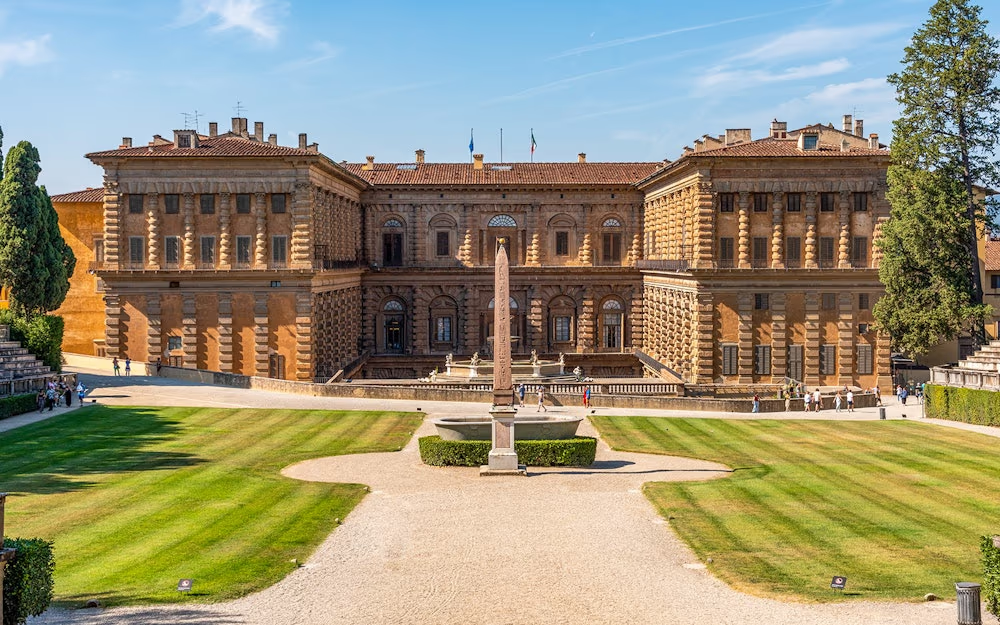
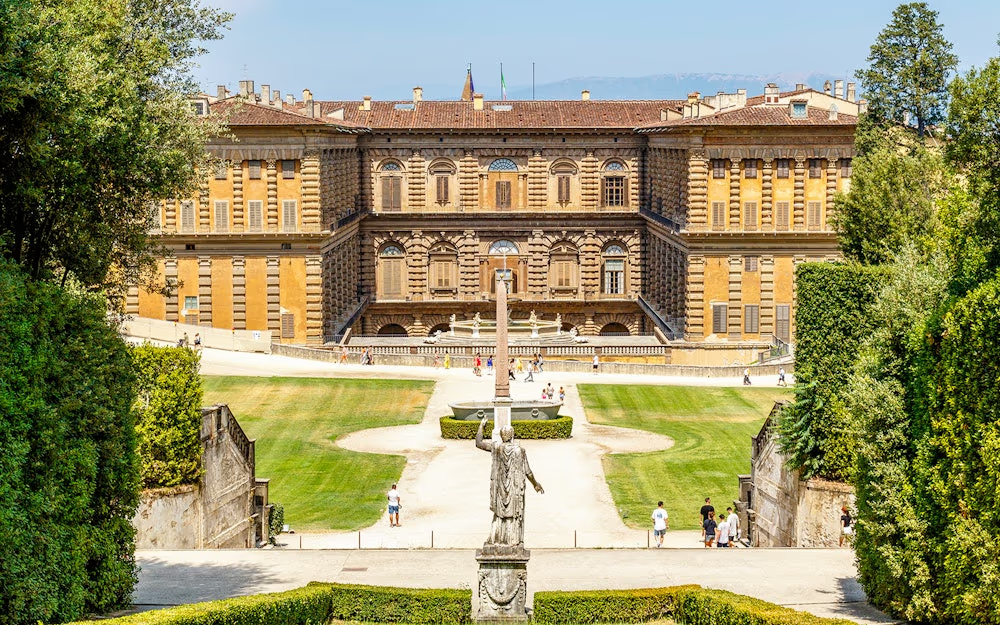
With the palace + Boboli combo, two outdoor pieces complete the list: the ancient Egyptian obelisk in the amphitheatre, brought to Florence from Rome and the only one in Tuscany, and the exuberant facade of Buontalenti's Grotta Grande near the exit toward the courtyard — sculpture, dripstone and frescoed fantasy fused into one Mannerist folly. Even seen from outside, the grotto explains what "Mannerism" means faster than any wall text.
Planning the two hours
Book the first morning slots and do the ten stops before the gallery fills; the halls are small and one tour group can own a Raphael for ten minutes. If you would rather have the stories told to you, a guided tour or the included audio guide covers most of these works. And if you are deciding between a quick hit and a full day, the how-long-to-visit page breaks down what fits into 2, 3 and 5 hours.
Frequently asked questions
What is the most famous painting in the Pitti Palace?
Raphael’s Madonna della Seggiola, the round Madonna in the Saturn Hall of the Palatine Gallery. His La Velata, in the Jupiter Hall, runs it close — the palace holds one of the largest groups of Raphael paintings anywhere.
Are there works by Michelangelo in the Pitti Palace?
No. Michelangelo’s Florentine works are elsewhere — the Accademia (David), the Bargello and the Uffizi. The Pitti’s strengths are Raphael, Titian, Rubens, Caravaggio and Andrea del Sarto in the Palatine Gallery.
Is Raphael really at the Pitti Palace?
Yes — the Palatine Gallery holds around a dozen Raphaels, including the Madonna della Seggiola, La Velata and portraits. It is one of the main reasons to visit the palace rather than treating it as a lesser Uffizi.
How many artworks are in the Pitti Palace?
The Palatine Gallery alone hangs roughly 500 paintings across 28 halls, and the palace’s other museums add thousands of further works and objects, from Macchiaioli canvases to grand-ducal treasures. Nobody sees it all in one visit — hence the 10-stop route on this page.
Is 2 hours enough for the masterpieces?
Two focused hours cover the 10 stops on this route with time to breathe. Add an hour if you also want the Royal Apartments and a look at the Modern Art gallery. The how-long-to-visit page has full timings for each ambition level.
Are all these works included in the standard ticket?
Yes. One palace ticket covers the Palatine Gallery and every museum mentioned on this page; only the Boboli Gardens sights need the combo ticket. Works do occasionally travel to exhibitions — a closed hall just means skipping one stop.