Answers in brief: what is the Pitti Palace?
The Pitti Palace (Palazzo Pitti) is a Renaissance palace in Florence's Oltrarno district, begun around 1458 for the banker Luca Pitti and bought in 1549 by the Medici, who made it the official residence of the grand dukes of Tuscany. It later housed the Habsburg-Lorraine dynasty and the Savoy kings of Italy, and since 1919 it has belonged to the Italian state. Today its roughly 32,000 m² contain five museums — led by the Palatine Gallery — with the Boboli Gardens rising behind it.
| c. 1458 | Luca Pitti commissions the palace to rival the Medici |
|---|---|
| 1472 | Luca Pitti dies; the palace stands unfinished |
| 1549 | Eleonora di Toledo buys it for Cosimo I de' Medici |
| 1565 | Giorgio Vasari builds the Vasari Corridor to the Uffizi |
| 1737 | Medici line ends; Habsburg-Lorraine take over Tuscany |
| 1865–71 | Florence is capital of Italy; the Savoy court moves in |
| 1919 | Vittorio Emanuele III donates the palace to the state |
1458: a banker's challenge to the Medici
Luca Pitti (1398–1472) made his fortune in banking and his name in politics as an ally of Cosimo the Elder — until ambition got the better of the alliance. Around 1458 he began a palace on the slope of the Boboli hill, across the Arno from the crowded centre, and Florentine tradition insists the brief was simple: build something whose windows were larger than the doors of the Medici's own palace on Via Larga.
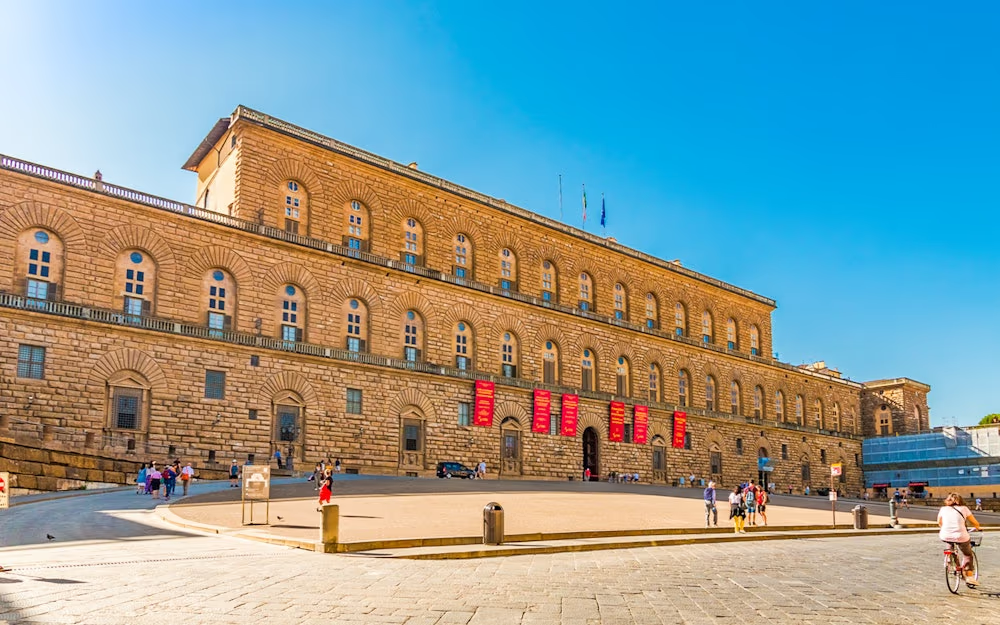
The design is traditionally attributed to Filippo Brunelleschi, the architect of the cathedral dome. Treat that attribution honestly: Brunelleschi died in 1446, a decade before construction started, so at most the palace follows an earlier idea of his. The architect actually documented on site is Luca Fancelli, a builder from Brunelleschi's circle who executed the severe original block — huge rusticated stones, three storeys of equal height, no marble, no ornament. That original palace was far smaller than what you see today: roughly the central seven bays of the present façade.
Pitti's gamble failed. In 1466 he joined a conspiracy against Piero de' Medici, Cosimo's son; the plot collapsed, and though Pitti was pardoned, his credit and influence never recovered. When he died in 1472, the palace was unfinished and the family's fortune was sinking. His heirs held on to the oversized shell for another three generations.

1549: the Medici buy their rival's palace
The irony arrived in 1549, when Eleonora di Toledo — the Spanish-born wife of Duke Cosimo I de' Medici — bought the palace from Luca's descendant Buonaccorso Pitti. The family that the building was meant to humiliate now owned it, and kept its rival's name on the door. Eleonora wanted air and gardens away from the damp Palazzo Vecchio; the court gradually moved across the river, and the Pitti became the seat of Medici power for nearly two centuries.
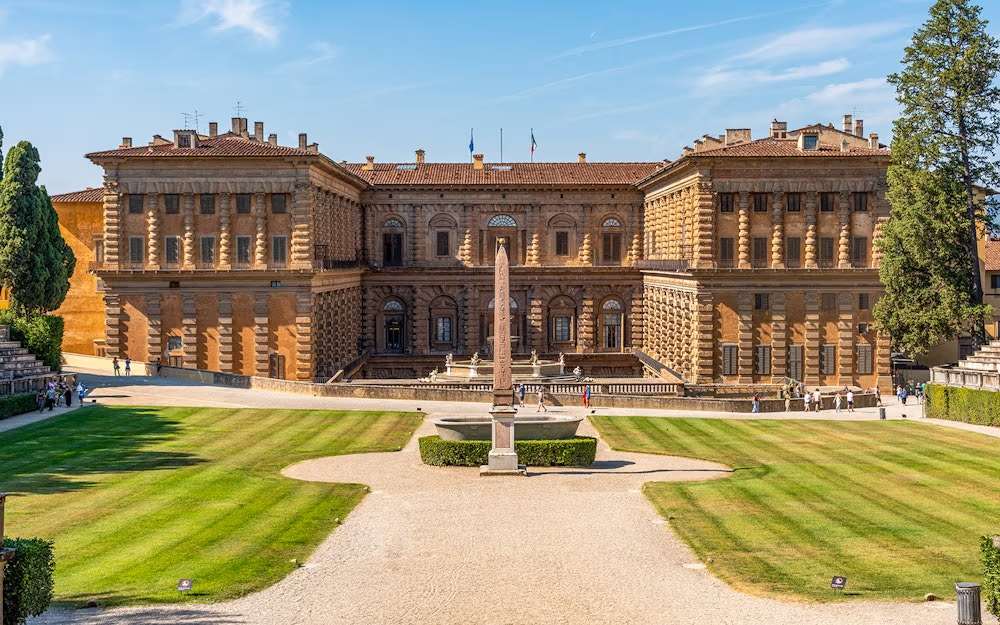
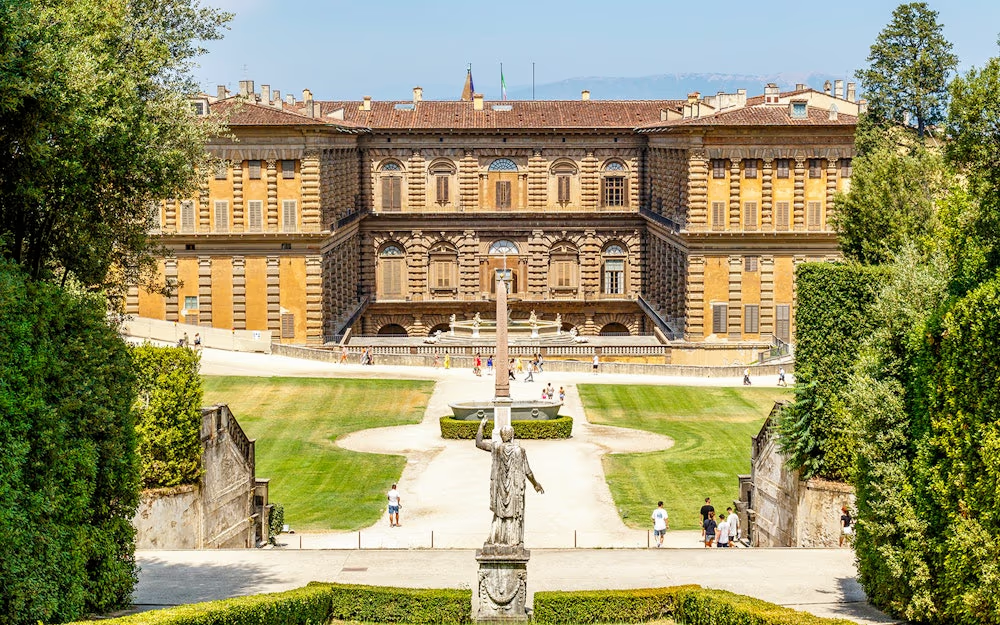
Cosimo hired Bartolomeo Ammannati to turn a banker's house into a ruler's palace. Ammannati's masterpiece is the courtyard (1560s) at the heart of the building: three tiers of rusticated columns, carved as if the stone were still raw, opening theatrically onto the hillside garden. On that hillside, Niccolò Tribolo laid out the first design of the Boboli Gardens shortly before his death in 1550, and Ammannati and Bernardo Buontalenti — creator of the famous grotto — carried the work on, turning the slope into the model for royal gardens across Europe.
1565: a private corridor over the Ponte Vecchio
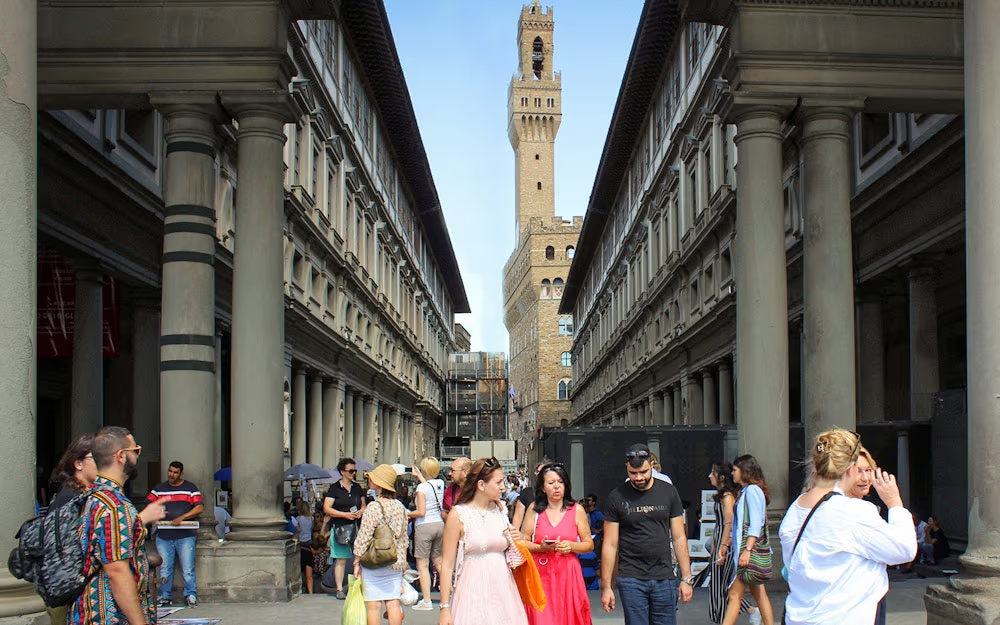
For the wedding of Cosimo's heir Francesco I to Joanna of Austria in 1565, Giorgio Vasari built the elevated passage that still bears his name. The Vasari Corridor runs about a kilometre from the Palazzo Vecchio through the Uffizi, above the goldsmiths' shops of the Ponte Vecchio, and into the Pitti Palace near the Boboli grotto — letting the grand dukes walk from government offices to home without touching a public street. It is the clearest architectural statement of what the Pitti had become: one end of the axis of absolute power in Tuscany.
Under Francesco's successors the palace kept growing. The 17th century added the frescoed planetary rooms that now form the heart of the Palatine Gallery, painted for the grand dukes by Pietro da Cortona, and the façade stretched wing by wing towards its current 200-metre sprawl.

1737: the Medici end, the Lorraine arrive
The Medici dynasty died out in 1737 with Grand Duke Gian Gastone, and Tuscany passed to the Habsburg-Lorraine family. Florence owes its treasures to that transition: Gian Gastone's sister Anna Maria Luisa de' Medici bound the family collections to the city forever in her "Family Pact", so the paintings, jewels and sculptures stayed in Florence instead of scattering to foreign courts.
The Lorraine were modernisers. They refitted apartments, commissioned the gleaming Sala Bianca ballroom, and under the reforming grand duke Pietro Leopoldo began opening the collections to visitors — the first step in the palace's long conversion from residence to museum. Their rule was interrupted only once: during the Napoleonic years, when Napoleon's sister Elisa Baciocchi governed Tuscany from the Pitti as grand duchess (1809–14), redecorating in the French Empire style before the Lorraine returned after Napoleon's fall.
1865: royal palace of a new Italy
When Florence became the capital of the newly unified Kingdom of Italy in 1865, the Pitti Palace got its last promotion: royal residence of King Vittorio Emanuele II of Savoy. For six years, until the capital moved to Rome in 1871, Italy was in effect governed from the Oltrarno. The Savoy court updated the state rooms you now visit as the Royal Apartments — a layer of 19th-century silk, gilt and portraiture laid directly over the Medici and Lorraine rooms.
In 1919, King Vittorio Emanuele III donated the palace and its collections to the Italian state. The dynastic story ends there; the museum story begins. The complex was progressively organised into today's five museums, from the Palatine Gallery to the Museum of Costume and Fashion, now managed together with the Uffizi by Le Gallerie degli Uffizi.
Through the 20th century
The palace's last dramatic chapter came in August 1944, when the retreating German army blew up every bridge over the Arno except the Ponte Vecchio. With the river crossings gone and the city a front line, the Pitti Palace threw open its doors and its courtyard became a refuge for thousands of displaced Florentines — a royal palace turned emergency shelter. Restored and reorganised in the decades since, it now operates entirely as a museum complex, while the Boboli Gardens and the palace together form part of the UNESCO-listed historic centre of Florence.
Why this history matters for your visit
- The Palatine Gallery is hung like a princely collection, paintings stacked to the ceiling in the Medici arrangement — not by date or school. Read our masterpieces guide before you go in.
- Every dynasty left a layer. Medici frescoes, Lorraine neoclassicism, Savoy furnishings — the Royal Apartments only make sense once you know who redecorated what.
- The Boboli Gardens are part of the same design. Palace and garden were conceived together; the combo ticket is the historically complete visit.
- Allow real time. Four centuries of accumulation take 2–3 hours minimum — see how long to visit.
Planning the practical side? Start with tickets and prices, check opening hours (closed Mondays), and see what visitors say about whether the palace lives up to its past.
Frequently asked questions
Who built the Pitti Palace?
The banker Luca Pitti commissioned it around 1458. The design is traditionally attributed to Filippo Brunelleschi, but since Brunelleschi died in 1446 the attribution cannot be literal; the architect who actually directed the works was Luca Fancelli, who trained in Brunelleschi’s circle.
Why is the Pitti Palace famous?
It was the seat of three ruling dynasties — the Medici grand dukes, the Habsburg-Lorraine and the Savoy kings of Italy — and today it holds five museums, including the Palatine Gallery with one of the world’s great collections of Raphael and Titian. It is also the largest palace in Florence, at about 32,000 m².
Who lived in the Pitti Palace?
The Pitti family until 1549, then the Medici grand dukes of Tuscany, the Habsburg-Lorraine dynasty from 1737, Napoleon’s sister Elisa Baciocchi during the French occupation, and finally the Savoy royal family, who used it as a royal palace when Florence was the capital of Italy (1865–71).
Who was Luca Pitti, and what does "Pitti" mean?
Pitti is simply the surname of the Florentine banking family who commissioned the palace. Luca Pitti (1398–1472) was one of the richest men in Florence and an ambitious rival of the Medici; he began the palace to outshine them, backed a failed conspiracy against them in 1466, and died with the building unfinished.
When was the Pitti Palace built?
Construction began around 1458 on the original, much smaller block. Work stalled when Luca Pitti’s fortunes collapsed, and the palace reached roughly its present size only under the Medici and their successors, through enlargements that continued into the 18th century.
Is the Pitti Palace worth visiting for its history alone?
Yes — few buildings let you walk through the Renaissance, the grand-ducal Baroque and the age of Italian unification under one roof. Visitors consistently rate the palace 4.4/5 (source: Headout); see our reviews page for what people praise and criticise.